EduDigiH2Lab
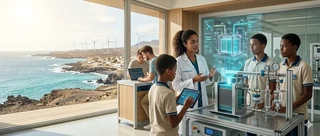
EduDigiH2Lab (Digital Hydrogen Laboratory: Environmental and Sustainability Education Through Immersive Learning) is a seed project led by Professor Janne Fengler together with Professor Bradley Ladewig from the University of Luxembourg, that brings together digital innovation, hydrogen science, and sustainability education. The project aims to transform the Paul Wurth Chair Hydrogen Laboratory into an immersive 3D learning environment, allowing students in Cabo Verde to access realistic experimental experiences virtually, even where physical laboratory infrastructure is limited. In doing so, it addresses the growing need to connect the green and digital transitions through accessible and forward-looking STEM education. 
The initiative is designed for two key learner groups: university students preparing for future careers in sustainable technologies, and primary and secondary school students who can benefit from early exposure to environmental awareness and digital literacy. By creating tailored learning modules around hydrogen and renewable energy, the project seeks to make complex scientific concepts more engaging, practical, and relevant for diverse audiences. Its distinctive contribution lies in combining immersive educational technology with development cooperation, opening up new possibilities for equitable and high-impact science education. 
EduDigiH2Lab is especially relevant in the context of Cabo Verde, where climate vulnerability, dependence on imported fossil fuels, and the need for technical capacity in renewable energy are closely intertwined. As the country advances its ambitions in clean energy and begins shaping a hydrogen roadmap, the project supports local capacity building by helping students, teachers, and institutions engage with hydrogen technologies and systems thinking for sustainability. It aligns strongly with broader goals in quality education, clean energy, innovation, and climate action, while also reflecting Luxembourg’s commitment to international cooperation in education and sustainability. 
Beyond the immediate pilot phase, the project is intended to lay the groundwork for a scalable and locally relevant digital hydrogen learning ecosystem in Cabo Verde. Through collaboration with universities, schools, NGOs, and public stakeholders, EduDigiH2Lab will assess local needs, test digital learning modules, and develop a roadmap for a larger long-term initiative. Its broader ambition is not only to improve knowledge and motivation in STEM, but also to strengthen institutional capacity and empower future generations to contribute actively to a more sustainable and climate-resilient society.
This work was supported by the Luxembourg National Research Fund (FNR) under Grant LUXAID BRIDGES/25/19931550.

