Preparation of porous ion-exchange membranes (IEMs) and their characterizations
Jan 19, 2011·, ,,·
0 min read
,,·
0 min read
C. Klaysom
S. H. Moon
Prof. Dr. Bradley P. Ladewig
G. Q. M. Lu
L. Wang
Abstract
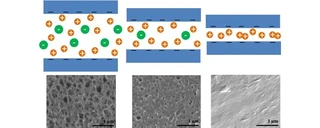
Ion-exchange membranes consisting of sulfonated polyether sulfone with controllable porosities and structures were prepared via a two-step phase inversion procedure. The porosity of membranes has been deliberately controlled by adjusting drying conditions. It was experimentally evidenced that membranes with high porosities possessed excellent conductivity; they also had poor selectivity and mechanical stability, while non-porous membranes exhibited much better selectivity and mechanical strength at the cost of lower conductivity. Porous membranes with 2.11 mequiv cm−3 of fixed charged density, 0.33 mS cm−1 of conductivity, 0.9 of transport number and ∼500 MPa of Young’s modulus were obtained by carefully controlling the two-step phase inversion preparation process. The results from this work lead to better understanding of the relationship among the formation conditions in water/dimethylformamide (DMF)/sulfonated polyether sulfone (sPES) system, structures and properties of membranes, which may shed light on advanced membrane design for appropriate applications.
Type
Publication
Journal of Membrane Science
