Impact of freeze drying on pore size distribution of amorphous silica membranes derived from gas permeation activation energies
Mar 19, 2026·,,,,,,, ,,·
0 min read
,,·
0 min read
Tanzila Anjum
Tian Heng Qin
Gianni Olguin
Yinxiang Wang
Dongkuan Zhang
Xiaonan Kou
David K Wang
Xiaozhen Zhang
Prof. Dr. Bradley P. Ladewig
Asim Laeeq Khan
Guozhao Ji
Abstract
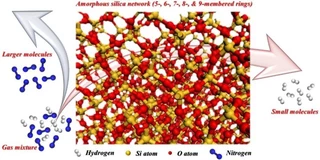
Microporous silica membranes have enormous potential to contribute to clean-energy applications by H2 separation, yet their separation performance is severely constrained by the presence of membrane pore defects due to traditional thin-film drying techniques. In this work, a mathematical modeling approach based on activation energy derived from empirical measurement of membrane gas permeation is proposed to quantitatively estimate the pore size distribution of amorphous silica membranes prepared by freeze-drying, demonstrating a synthesis-structure-transport property correlation. The synthesis of cobalt-doped silica membranes was performed through evaporation drying and freeze drying, and the membranes were tested using He and N2 single-gas permeation at 200–500 °C. Apparent activation energies were determined using an activated transport assumption based on the Oscillator model and Effective Medium Theory (EMT) to estimate the relative roles of siloxane ring sizes in the amorphous silica network. The reconstructed pore size distribution was validated by the modeled activation energies and gas permeances that were in close agreement with the experimental values. The results showed that freeze-dried membranes had a higher percentage of 5- and 6-membered rings (98.5% collectively) and a reduced contribution of larger rings, which suggests a more compact and homogeneous microporous structure. These findings indicate that freeze drying can effectively regulate the pore structure of silica membranes and that activation-energy-based analysis is an effective method to determine the pore size distribution of amorphous silica membranes.
Type
Publication
Separation and Purification Technologies
