Data-Driven Evaluation as a Preliminary Tool to Judiciously Choose Covalent Organic Frameworks to be used as Fillers in Mixed Matrix Membranes for Hydrogen Separation
Mar 19, 2026·, ·
1 min read
·
1 min read
Kris Helten
Nicholaus Prasetya
Prof. Dr. Bradley P. Ladewig
Abstract
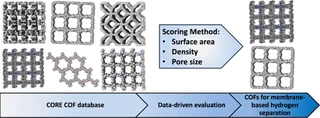
Hydrogen is considered the fuel of the future for the decarbonizing industry and the transport sector. A membrane containing porous materials can be used to extract hydrogen from various gas mixtures. The diversity of porous materials makes it difficult to select a specific material for hydrogen separation. Covalent organic frameworks (COFs) are becoming increasingly popular for gas separation processes, especially for high-temperature applications. The properties of a COF depend on the configuration of various building blocks. A data-driven evaluation was performed to select the most promising COF features and topologies from the CoRE COF database of 1242 reported COFs based on quantification using a scoring approach. The results of the property-based evaluation model show that 3D COFs have a higher potential on average than 2D COFs. Four different normalized evaluations describe the design with the highest potential. The interdisciplinary quantification approach of the preferred properties enables the selection of a specific topology from 2D or 3D covalent organic frameworks and serves as an indication of further advantageous features for a selective hydrogen separation material.
Type
Publication
ACS Omega
This article was published in an earlier form as a preprint, available from ChemRxiv: https://chemrxiv.org/doi/full/10.26434/chemrxiv-2025-085wt
